Monday, 19 February 2018

Fitness Apps and DevicesπŸƒπŸ“±

iReach Insights Press Release
   
SIGN UP, TAKE PART in our surveys for free and GET REWARDED! iReach Conversations


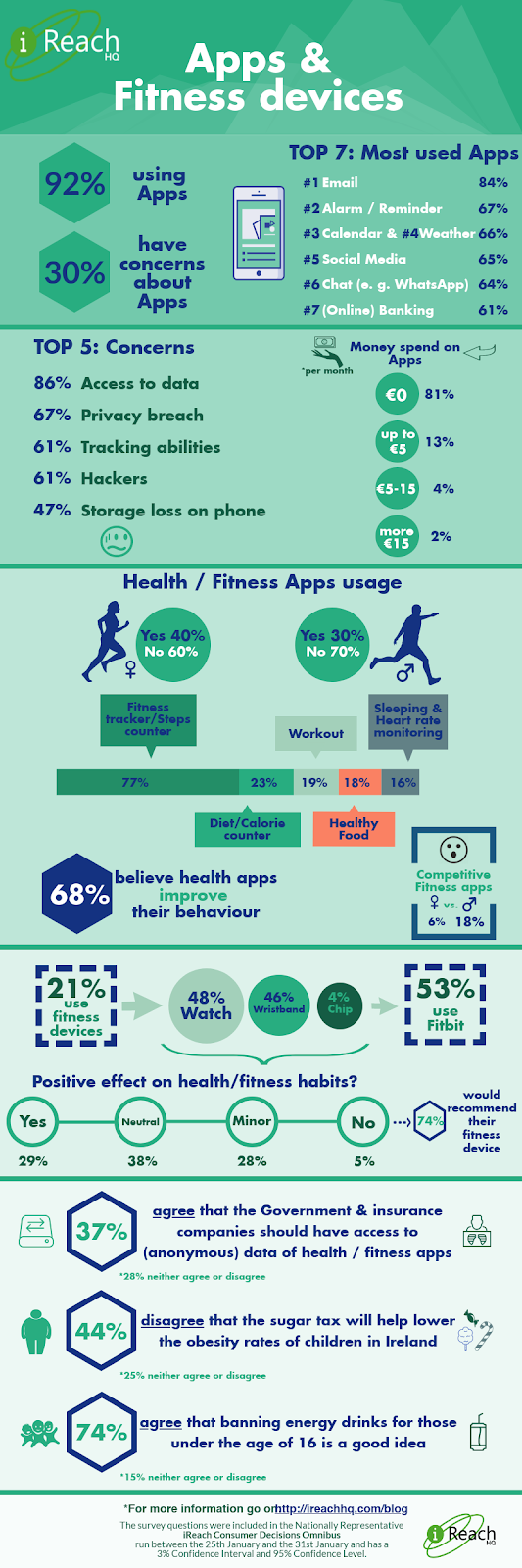
  • 30% of people using apps have serious concerns about them.
  • TOP 3 concerns adults in Ireland have about apps are: 1. Access to personal data (86%), 2. Privacy breach (67%), 3. Tracking abilities (61%).
  • 35% of app users in Ireland use apps concerning their health, body, fitness and/or diet.
  • Surprisingly, 37% agree that the Government & insurance companies should have access to (anonymous) data of health & fitness apps.
  • More women (40%) than men (30%) in Ireland use health and/or fitness apps and 68% of them believe health apps improve their behaviour.
  • One in five adults in Ireland use a fitness device.
  • Three out of four (74%) would recommend their fitness device.
  • Most app users (81%) use free of charge apps.


Since smartphone and tablet technology is an integral component of the lives of people in Ireland and the New Year’s resolutions might still be in the back of some people minds, it seems like more people are using apps to improve their health and fitness behaviours. 
iReach Insights conducted nationally representative survey and 1,000 adults were asked about their opinion about apps in general, their usage of health and fitness apps and fitness devices.

Almost everyone has a smartphone and/or a tablet (92%) and 92% are using apps on their smart devices. Unfortunately, 30% of those using apps, have serious concerns about using apps. The TOP 5 concerns adults in Ireland have about apps are: 1. Access to personal data (86%), 2. Privacy breach (67%), 3. Tracking abilities (61%), 4. Hackers (61%) and 5. Storage loss on phone / tablet (47%).

The majority of app users (81%) are using free of charge apps and only 19% pay for using the apps each month. Of those (19%) they pay an average of €5.85 a month.

35% of app users in Ireland use apps concerning their health, body, fitness and/or diet. More women (40%) than men (30%) use these health/fitness apps. Here are the TOP 5 health and fitness apps used: 1. Fitness tracker / Steps counter (77%), 2. Diet / Calorie counter (23%), 3. Workout /fitness program (19%), 4. Healthy food (18%) and 5. Sleep monitoring (16%).
The biggest gap between male and female health app usage can be found on competitive fitness apps. 18% of men, but only 6% of women use them. All in all, two-thirds (68%) believe health / fitness apps improve their behaviour.
One out of five people living in Ireland (21%) uses a fitness device and over the half of them (53%) use Fitbit. In terms of the device used, 48% have a watch, 46% a wristband and / or 4% a chip as a fitness device. Also, the majority (57%) think that fitness devices have some kind of positive effect on their health and fitness habits. Furthermore, three out of four (74%) would recommend their fitness device.
On the topic of health apps and fitness devices, people living in Ireland were asked, if they think that the Government and insurance companies should have access to (anonymous) data from any kind of health or fitness apps. Inconsistent with the TOP 1 concern about apps, which is access to personal data, 37% think, that the Government and insurance companies should have access to the data to improve the Irish health system and to create specific health programs.
In light of the health topic and the possibility of the incoming sugar tax, 44% of people in Ireland think that the sugar tax won’t help lower the obesity rate of children, but 74% agree that banning energy drinks for those under the age of 16 is a good idea.

These results show that health & fitness apps and devices seem to offer an actual support in changing and improving habits in people’s daily lives.

For more information on these research findings please feel free to call iReach on 01-2143740 or email to oisin.byrne@ireachhq.com


What about you? Share and comment!


SIGN UP, TAKE PART in our surveys for free and GET REWARDED! iReach Conversations

Tuesday, 13 February 2018

Valentine's Day πŸ’˜πŸ˜πŸ‘«

iReach Insights Press Release   
SIGN UP, TAKE PART in our surveys for free and GET REWARDED! iReach Conversations

  • Although 71% of us don’t like Valentine's Day 61% of us in a relationship will still celebrate it.
  • 61% of adults in Ireland will celebrate Valentine’s Day.
  • 58% of men and 46% of women living in Ireland will buy a present for their partner.
  • Top gifts include: Card (52%), Chocolates (34%), Flowers (33%), Aftershave / Perfume (14%) and Wine / Champagne (9%).
  • 64% say that spending too much time on the phone during a dinner date is the worst nightmare.
  • Liam Neeson (23%) and Amy Huberman (22%) are the favourites for celebrity Valentine’s Dates.
  • Brian O’Driscoll and Amy Huberman (27%) are Ireland’s favourite celebrity couple, followed by Michael D and Sabine Higgins (17%) and Daniel and Majella O’Donnell (11%).
29% of people in Ireland state they are a fan of Valentine’s Day and 71% aren’t. The number of people that is a fan of Valentine’s day has increased in the year 2018 (last year – 26% of people were fans of V day).

The TOP 3 reasons for people that are fans of Valentines day::
1. Good reminder to appreciate your relationship (58%)
2. Nice day to think about your partner (56%)
3. It celebrates love (50%). 

Here are the TOP 3 reasons for people not to be a fan: 
1. Too commercialised (79%)
2. Everything is overpriced (45%)
3. Not special (31%)

Although 71% of us don’t like Valentine's Day 61% of us in a relationship will still celebrate it. Of those of us who are not in a relationship, one in five (20%) will celebrate Valentine’s anyways. This figure has almost doubled since last year with only 11% of singletons celebrating it last year.
60% of people will celebrate Valentine’s day with dinner, 24% will stay in and watch a movie and 17% will order takeaway. Just half (52%) of people in Ireland are going to buy something for their partner (More males – 58% than females – 46%). Top gifts include: Card (52%), Chocolates (34%), Flowers (33%), Aftershave / Perfume (14%) and Wine / Champagne (9%).

Unlucky for some – 13% of adults in Ireland have forgotten about Valentines Day when they were in a relationship. We also wanted to find out what people think are the most annoying habits when out on a dinner date. Top most annoying habits are; 

1. Being on the phone (64%) 
2. Being Rude to waiting staff (60%) 
3. Talking about their ex (57%)
4. Bad manners (54%)
5. Forgetting their name (39%)


People identified their perfect Valentines dates:

Amongst the men the TOP 3 are 
1. Liam Neeson (23%), 
2. Jamie Dornan (22%)
3. Colin Farrell (12%). 

Amongst the women, the TOP 3 are 
1. Amy Huberman (22%)
2. Saoirse Ronan (19%)
3. Laura Whitmore (19%). 

Who tops the leader board for the favourite celebrity couple? Brian O’Driscoll and Amy Huberman (27%) do, closely followed by Michael D and Sabine Higgins (17%) and thirdly Daniel and Majella O’Donnell (11%).

For more information on these research findings please feel free to call iReach on 01-2143740 or email to oisin.byrne@ireachhq.com


What about you? Share and comment!


SIGN UP, TAKE PART in our surveys for free and GET REWARDED! iReach Conversations

Tuesday, 6 February 2018

Social Media Responsibility: 64% of people in Ireland think that the acceptable age to start using social media is between 14 and 17 years!

iReach Insights Press Release   
SIGN UP, TAKE PART in our surveys for free and GET REWARDED! iReach Conversations


  • 55% think that more restrictions should be put in place on content posted on social media.
  • 64% of adults in Ireland think that between 14-17 years old is the appropriate age to start using social media.
  • 66% of people in Ireland are a member of at least one social media platform.
  • 89% of these are members of Facebook, followed by 68% who are subscribed to YouTube and 42% signed up to Twitter.
  • 62% of women in Ireland think there should be more restrictions and policies put in place on social media platforms.
  • Over the half of people in Ireland (59%) think that the individual and the social media platform itself are equally responsible for the content posted on the platform.
  • Almost two-thirds (64%) of adults in Ireland think that between 14-17 years is the appropriate age to start using social media.

It has been reported widely in the media about the growing issue of technology and smartphone addiction amongst the younger generation, meaning the importance of education and regulation surrounding online networking and social media has never been more vital. Today is Safer Internet Day, which is an EU wide initiative to promote a safer internet for all users, especially young people. Facebook is making it easier for users to find privacy settings, establishing a new privacy centre in an effort to give users more control of their information. “Privacy controls are only powerful if you know how to find and use them,” Erin Egan, Facebook’s chief privacy officer, said in a blog post. 

Despite having the option to change your privacy settings 13% still have their Facebook privacy on Public. The announcement was made in anticipation of the EU’s new General Data Protection Regulations, which comes into effect on 25 May this year. Three quarters of people are consuming some sort of social media content and 66% are members of a social media platform. It is no surprise that social media plays a bigger role in society and that impact will probably increase in the future.

iReach Insights conducted a nationally representative survey and 1,000 adults were asked about their opinion about social media in general, who the responsibility lies with when it comes to posting on social media and the restrictions that should be imposed.


As mentioned above, two thirds of adults in Ireland (66%) are a member of a social media platform.  81% of people in the 16-34 age group, 63% in the 35-54 group and 43% in the 55+ group are a member of at least one social media platform, revealing the popularity of social media platforms amongst the younger age cohort. From the 66% in total, 89% are a member of Facebook, followed by 68% of YouTube, 42% of Twitter, 39% of Instagram and 30% of LinkedIn [28% Snapchat, 23% Pinterest, 22% Skype].

The majority of people in Ireland (55%) think that more restrictions and policies regarding the content that can be posted on social media should be put in place. Interestingly, 62% of women share this opinion whereas only 47% of men do.
Only 7% say that the existing restrictions and policies are too strict. Not forgetting that 25% are unsure of the restrictions and policies that are currently in place. In general, three quarters (74%) think that it isn’t appropriate to share shocking images or videos on social media platforms surrounding sensitive topics.


When it comes to the responsibility for content that is posted online on social media, 59% state the individual is responsible. All the same, 59% think the social media platform itself is equally responsible. 34% place the responsibility on online regulatory authorities, 14% on the government and 8% on the police. Understandably, 83% of adults in Ireland say, that smartphones should offer more settings to protect children and teenagers.
 
When talking about responsibility and the potential damage social media platforms can cause, it is important to mention privacy settings which can protect people online to some extent. For the Top 4 platforms most used by people in Ireland: on Facebook 17% set their account on ‘totally private’. Over half (66%) on Facebook set their account to ‘private’, 13% on ‘public’ [4% don’t know their settings].

Ireland has opted for the lowest age permissible under upcoming EU data law which is 13 years old. In Ireland, it means that Facebook, Google, Twitter or any other company can mostly (though not fully) use a 13-year-old's personal information in the same way they would use an adult's information. Almost two-thirds (64%) of people in Ireland think that the acceptable age to start using social media platforms is between 14 and 17 years and not any younger. 23% state the right age is 18+. 11% state that the age between 11-13 is acceptable and the minority (2%) thinks 10 years or younger is appropriate.

Even though social media platforms are not new anymore, a lot of people still have big concerns about them and wish for stricter policies and restrictions. Facebook is moving in the right direction and making the privacy settings more visible for their users. So what else can be done to minimize potential negative consequences and to bring out the more positive impacts of social media?
For more information on these research findings please feel free to call iReach on 01-2143740 or email to oisin.byrne@ireachhq.com


What about you? Share and comment!


SIGN UP, TAKE PART in our surveys for free and GET REWARDED! iReach Conversations

Thursday, 1 February 2018

What is Influencer Marketing?

Measuring the Impact of Influencers on your brand


Are there different flavours of influencer marketing?

Yes, there are different flavours’.

There is the celebrity or category influencer model, where brands engage with people who are influential in their vertical or industry but may not yet be customer advocates (think: Shure Microphones using J-Lo or Lansinoh baby bottles using influential mom bloggers.)

There is the everyday, brand advocate model. This involves identifying people who are actual customers/users of your brand, product, or service, who are also advocates looking for an opportunity to build a closer relationship with the brand they love.

Large consumer brands have millions of such advocates, many who have enormous influence. Connecting with these people has proven to have more impact, including long-tail impact, than celebrity influencer campaigns, although both flavours often run side-by-side and can complement one another.

Finally, as mentioned above, there are opt-in influencers, who can be “rented” – in exchange for sweepstakes entries, coupons, or other sponsored programs – to post about the brand on social.

This should not be considered a “flavour” of influencer marketing, since even a quick look at the “#sponsored” hashtag on Twitter will reveal that these people do not spur engagement, they do not have real followers, they tweet about competing brands, and they are not remotely authentic.

The profiles that engage with these opt-in, incentivized programs are built solely for the purpose of entering sweepstakes or getting free products. These “influencers” will hurt your brand, so when I think “influencer marketing,” I do not include this group. (See this article on the stark reality of this kind of these incentivized influencers.)

What’s the most challenging aspect of influencer marketing? Identifying influencers? Actually engaging them? Tracking the impact?

Brands face issues around all three, really, but each activity has its own obstacles.

On the measurement front, there is a huge shift going on.

Metrics used to fall into the “reach” or “impressions” bucket, because that’s what people were used to and comfortable with, and that’s what they were being offered by vendors. The reality today is that there’s an enormous opportunity for brands to measure much, much more when it comes to word-of-mouth and influencer strategies; they just need the tools to do it.

That being said, “reach,” as a KPI, is on the outs. It’s still worth looking at as a general metric, but it shouldn’t serve as an indicator of performance or be considered a success metric.

Here’s what I’m talking about. As a web marketer, I might measure website visits, but a spike in visits doesn’t automatically signal success for me. Quality visits, however, do. If visits don’t provide a desired result (conversions, purchases, downloads, etc.), then a spike does me no good.

People should think about reach in the same way. If a spike in reach does take place, it’s the responsibility of the brand, the agency, AND the vendor to validate that this reach translated into actual, quality results. Did it result in reviews? Did it result in sales?

In other words, you always must ask, “What did I want from influencers in the first place and did increased ‘reach’ get me there?”
Measuring success is a mix of the right tools coupled with the right strategies, and sometimes takes a little bit of thinking and planning.
The fact of the matter is, success in influencer marketing can be measured, and there really isn’t an excuse anymore for measuring quantity over quality.

So, what is influencer marketing, actually?

This should really be two questions. The first is, “What are people actually doing when they say they’re doing influencer marketing?”

The second is, “What do you think ‘influencer marketing’ SHOULD BE?”

Influencer marketing should be as follows: Brands partnering with people who have influence over their own networks, both on- and offline, who will spread authentic word-of-mouth for those brands, and who create real impact and business value for the brand when they do so.

The influencers brands partner with should either be influential within the industry or space that the brand is directly a part of, or they should be customers/potential customers of the brand already. In other words, if I see an influencer promoting something, I ask myself, “Do I have reason to believe that this person would authentically use this product or service even if they weren’t in a partnership with the brand?”

Influencer marketing all too often boils down to: Brands and agencies getting people – celebrities, social celebs, bloggers, etc. – who seem to have a large follower count to share tweets or content in exchange for a fee, free stuff, or entry into a sweepstakes, regardless of whether or not that person has any expertise or is even likely to be a user of the product or service.
 
What is it NOT?


Influencer marketing is NOT the use of influencers who are not already fans of your brand or have no influence in your category or vertical.

It is NOT engaging with influencers who share or distribute content from your competitors (which is extremely common).

It is NOT working with influencers or other people who do not have expertise in your industry, service, or vertical.

It is NOT asking any consumer who is willing to tweet a hashtag to become an influencer without first vetting them.


Brands need to find people who, when they talk about a brand, service, or product, are viewed as authentic and true customers/advocates of the brand. (See this Gawker article for a nice summary of what’s happening right now and how this is all changing.)


Identifying Influencers

On the identification front, many brands don’t have the resources to manually sift through their communities to find good people, and when they do have the resources, often all they have to go on is a single “comment” or some other isolated action.

It’s extremely important to understand who potential influencers are as people. When they talk, do they influence other people? Have they interacted with your brand before? I
f so, how many times and in what way? How passionate are they? What drives that passion? And so on.

Engaging Influencers

There is the challenge of simply being a good marketer and knowing your audience well enough to create content and marketing that resonates with them and generates engagement.

Still, from a strategy perspective, there are many things that brands miss out on when it comes to engagement. Engagement must spur advocacy. That is, when an influencer interacts with your brand, it’s important to make these interactions visible to that person’s network.

For example, when you give people the opportunity to connect, interact, or engage, you should also give them an opportunity to share and bring their friends into the conversation. Always provide a catalyst for this kind of advocacy or word-of-mouth marketing. And make it easy to do; don’t force influencers to find their own way of getting the word out.

Brands often miss this last point and influencer conversations happen on the brand’s site, or within the brand’s community, and stay there, never finding their way into the larger network of that influencer’s connections.

The brands that are best at engaging people are the ones who aren’t afraid to be personable and build relationships with people. Brands need to be able to step out of that “corporate” persona, especially on social, and let people feel like they’re interacting with some ONE, not some THING

Finally, brands need to think of word-of-mouth as a channel, something that’s always on and that builds exponentially over time. They need to treat word-of-mouth and influencers the same as they would any other channel in their mix (e.g., PR, display, eCommerce, etc.) and not just think in terms of campaigns.


To find out more about iReach Insights, check out our website: http://ireachhq.com/
Thursday, 25 January 2018

Smartphone Addiction: 47% of all millennials think they are addicted to their phoneπŸ“±πŸ˜²

iReach Insights Press Release
   
SIGN UP, TAKE PART in our surveys for free and GET REWARDED! iReach Conversations


  • 83% of Irish people think smartphones should offer more protection for children and teenagers.
  • 48% of people feel anxious when they don’t have their phone on them.
  • 92% of people in Ireland have a smartphone.
  • 8% of Irish have physical problems due to their mobile use.
  • Of those who suffer from physical problems due to smartphone use, more than the half (57%) of them suffer from neck problems.
  • 66% state that wasting time is a harmful side effect of using a smartphone.
  • Almost the half of people in Ireland (48%) think smartphones should not be allowed in schools at all.
  • Almost two-thirds (64%) of people with children who own a smartphone think that their child is addicted to their mobile.

Having a mobile phone nowadays is more of a necessity rather than a status symbol. This statement is in light of our recent survey, that reveals that 92% of Irish adults have a smartphone. The majority of the Irish (66%) think it is necessary to have a smartphone nowadays.
iReach Insights conducted nationally representative survey and 1,000 adults were asked about their mobile use and their opinion about smartphones in Irish society. The survey has a 3% Confidence Interval and a 95% Confidence Level.

92% of our respondent’s state that they have a smartphone. 7% have another kind of mobile phone and only an unbelievable 1% say they don’t have a mobile phone at all. The average amount of time that people admit to spending on their phone is approximately 1hour and 45 minutes each day, although in reality this could be much more.
65% admit that they find themselves using their phone during work for non-work-related issues. That concerns 79% of the 16-34 age group and 67% of the 35-54 age group, but only 30% of the 55+ age group. Currently in the workplace, one-third of the smartphone users (31%) need their smartphone for work in order to do their job!

It’s no surprise that almost the half (47%) of the millennials (18-34) think they are addicted to their phone, whereas it is 31% of the 35-54 age group and only 16% of the oldest age group (55+). The younger you are the more likely that you are addicted to your phone. This is highlighted further by the fact that a total of 48% feel anxious when they don’t have their phone with them. According to our respondents, these are the top 3 harmful side effects of over using smart phones: 1. Time wasting (66%), 2. Losing social contacts in real life (60%) and 3. Loss of other hobbies (49%). Furthermore, 84% state that they check their phone “occasionally” up to “all the time” even they don’t see or hear receiving a message or notification etc. Only 2% state that they never check their phone without an alarm signal.

80% of the Irish noticed that people are increasingly on their phones when they are socializing with friends or family. But more than that, 82% find it rude when people are on their phone excessively when out socialising. More female (86%) think this than males (78%). Furthermore, 83% feel annoyed by people using their smartphones in public without turning off the sound.
Smartphones have only been around a short while and alarmingly 8% of the Irish have suffered from physical problems due to an overuse of their phone – not to forget the 14% who are not sure. The Top 5 health problems those 8% of people suffer from overusing their phone: 57% have neck problems, 45% eye problems, 37% headaches, 32% back tensions and 24% suffer from finger or hand tensions. Despite having smartphones having such a huge impact on people physical health, 40% tried to reduce their phone use, but miserable failed and 14% didn’t even try to reduce the amount of time on their phone

From our 174 respondents with a child that owns a smartphone, 64% of these think that their child is addicted to their phone. Even worse, 88% of all respondents think that Irish Teenagers are addicted to their phones. Unsurprisingly, almost the half (48%) of the Irish society think that children should not be allowed to use their smartphones at all in school. 29% think smartphones should only be allowed to be used in a case of emergency. This means, less than one in 5 (18%) think it is appropriate for children to use a smartphone in school. Understandably, 83% of the Irish say, that smartphones should offer more settings to protect children and teenagers.

In light of these results, maybe Irish Society should think about how we teach our children to use and handling mobile phones, and other technologies such as tablets and laptops. Above all, we can’t know yet what effects the increasingly use of smartphones will have on our bodies. Especially the younger generations who are growing up with smartphones will probably deal with more physical problems, since our heads and necks are not made for looking down all the time. Only time will tell what effect smartphone will have on Irish Society.
For more information on these research findings please feel free to call iReach on 01-2143740 or email to oisin.byrne@ireachhq.com


What about you? Share and comment!


SIGN UP, TAKE PART in our surveys for free and GET REWARDED! iReach Conversations

Tuesday, 16 January 2018

Mental Health: 81% of people think that it has a stigma attached to it! 😷

iReach Insights Press Release   
SIGN UP, TAKE PART in our surveys for free and GET REWARDED! iReach Conversations


  • 81% of people still think that mental health has a stigma attached to it.
  • The top 3 activities that people do to improve their mental health is 1. Exercise (62%), 2. Sleeping (60%) and 3. Taking time for themselves (49%).
  • 37% think that there aren’t enough helplines and easy access to contacts in Ireland for people who would like help.
  • 41% think mental health is a topic you can’t talk about openly in Irish Society.
  • 81% of people still think that mental health has a stigma attached to it.
  • 73% of people think employers in Ireland should take mental health days as seriously as sick days.
  • In reality, 69% of people don’t think employers in Ireland do take mental health days as seriously as sick days.


Statistically, yesterday was the most depressing day of the year and with 47% of adults in Ireland feeling deflated and low returning to work this January. We decided to ask our panel about their mental health. IReach Insights conducted a nationally representative survey of 1,001 adults in Ireland who were asked about the importance of mental health and different things they do in order to improve their mental health. The survey questions were included in the Nationally Representative iReach Consumer Decisions Omnibus run between the 11th January and the 15st January and has a 3% Confidence Interval and 95% Confidence Level.


81% of adults in Ireland stated that mental health is important to them. The top 3 activities that people do to improve their mental health is 1. Exercise (62%), 2. Sleeping (60%) and 3. Taking time for themselves (49%). This survey also looked at the difference between genders and the way in which the different sexes find different solutions for improving their mental health. The Top 3 differences between the gender is 1. Meeting up with friends / family with 29% of males doing this and 56% of females doing this. 60% of females take time for themselves compares with 37% of males. Unsurprisingly a lot more females (29%) than males (8%) partake in retail therapy.
In the survey we asked if people think that there are enough helplines and easy access to contacts in Ireland for people who would like to get help! Opinions were divided with 37% responding that no there are not, 33% think there is and 30% are on the fence stating they are unsure. When we consider the regional differences, opinions varied widely. Of those 37% saying that there not enough helplines or easy access to contacts in Ireland for people: Dublin – 32%, Rest of Leinster – 45%, Munster – 36%, Connacht/ Ulster – 44%. This suggests that there is more helplines and access to contacts in Dublin compared to other parts of Ireland.
Although there is increased media coverage surrounding mental health issues and various celebrities having come forward in recent years to talk about their own mental health issues, a huge 81% of people still think that mental health has a stigma attached to it. In general, 41% think mental health is a topic you can’t talk about openly in Irish Society, 36% think you can talk about it openly and 22% are unsure.
Unsurprisingly, 64% of people in Ireland think that we suffer from mental health issues more nowadays than in the past. In comparison to other countries, 42% of people think Irish people are less open than other nationalities about talking about mental health issues. It can be difficult to approach the topic of mental health with employers, but in some cases, this is necessary if you need to take time off. 73% of people think employers in Ireland should take mental health days as seriously as sick days. In reality, 69% of people don’t think employers in Ireland do take mental health days as seriously as sick days.
We have made progress in recent years, especially in raising awareness when it comes to mental health and wellbeing. With that in mind the most popular initiatives that can be implemented to help those with mental health issue is Education in Schools / Universities (71%), Reducing the Stigma (67%) and talking more openly about it (65%).

 For more information on these research findings please feel free to call iReach on 01-2143740 or email Oisin at oisin.byrne@ireachhq.com


What about you? Share and comment!


SIGN UP, TAKE PART in our surveys for free and GET REWARDED! iReach Conversations


Tuesday, 9 January 2018

New YearπŸŽ‡πŸŽ‰

iReach Insights Press Release   
SIGN UP, TAKE PART in our surveys for free and GET REWARDED! iReach Conversations

  • 60% of people in Ireland plan to eat healthier after Christmas.
  • Half (50%) of women are on a diet in January 2018.
  • 47% of people feel deflated and low when they returned to work in January.
  • 60% of this 47% see the end of the fun and festivities as the reason they get the Winter Blues after the Christmas break.


Christmas and New Year seems like a distant memory at this point, although most of us have only been back to work one week! iReach Insights conducted nationally representative survey on over 1,000 adults in Ireland who were asked about New Year’s resolutions and feelings about going back to work in January!  
The survey questions were included in the Nationally Representative iReach Consumer Decisions Omnibus run between the 14th December and the 18st December and has a 3% Confidence Interval and 95% Confidence Level.


After Christmas, almost half of all adults in Ireland (47%) felt deflated and low when they returned to work in January. This affects more females than males with 44% of men quoting that they feel this way after holidays, whereas 51% of the female respondents do. Surprisingly only 27% of the 55+ age group claim they will feel deflated and low.

Of those who feel deflated and low when they return to work in January, the majority (60%) of all adult’s state that the feeling of getting into a slump after the fun and festivities have ended being the reason. Lack of bright light available naturally due to shorter winter days is another reason for having the Winter Blues after the Christmas Break. 

Christmas time can be an expensive time for some adults in Ireland and 30% of adults cite having unpaid credit card bills for Christmas expenses another reason for the Winter blues. Interestingly, it seems the older you are the more likely are to be affected – affects 21% of 18-34 years old, 35% of 35—54 years and 38% of those over the age of 55.

How did people in Ireland celebrate New Year’s? It’s no wonder that more than half (53%) of our respondents planned to stay in and stay up for the countdown and a further 14% stayed in and didn’t ring in the new year. Even the younger adults (18-34) barely want to celebrate in town for a night out (22%) or at a party (15%).

New Year – New you? Not if it concerns the Irish. In fact, only 26% of Irish adults made a New Year’s resolution this year. However, over a third (39%) are dieting this January. A lot more females are dieting than males. Every second women started a new diet in 2018, just 28% of men have. Like every year, it is not a surprise that the majority (60%) of adults in Ireland state to try to eat healthier after Christmas time.

 What about you? Share and comment!


SIGN UP, TAKE PART in our surveys for free and GET REWARDED! iReach Conversations